Start with what you buy
Before anyone draws a shelf, sort what the pantry holds into five groups, because each one wants a different shelf:
- **Cans and jars:** soup, beans, tomatoes, sauces, peanut butter.
- **Boxes and bags:** cereal, pasta, rice, crackers, snacks.
- **Bottles:** oil, vinegar, syrups, and drinks if they live here.
- **Bulk and paper:** paper towels, flats of water, pet food, the warehouse-club extras.
- **Small appliances and serving pieces:** the stand mixer, slow cooker, air fryer, platters and the holiday roasting pan.
A quick way to size it is to empty your current pantry onto the counter group by group and measure how many inches of shelf each group fills when it is lined up one item deep. Add about a third for growth and for the weeks after a big shopping trip. That number, not the size of the room, tells you how much shelving each group needs.
Pantry shelving depth by what you store
The rule that runs through every good pantry is that shelves are shallower than closet shelves. A shelf is only as useful as what you can see on it.
| What you store | Typical size | Shelf depth | Space between shelves |
|---|---|---|---|
| Cans and jars | A No. 300 soup can is 3 in across and 4 7/16 in tall | 12 in | 7 to 8 in |
| Cereal, pasta, crackers | Tall boxes, stood upright | 12 in | 12 to 14 in |
| Bottles | Oil, vinegar, syrups | 12 in | 12 to 14 in |
| Small appliances | Mixer, slow cooker | 14 to 16 in | 16 to 18 in |
| Bulk and paper goods | A No. 10 can is 6 3/16 in across and 7 in tall | 14 to 16 in, low | 10 in or more |
| Counter or landing shelf | Working surface | 18 to 20 in | At 36 in high |
Can sizes come from the industry codes in USDA Agriculture Handbook 697, where a No. 300 can is coded 300 x 407: 3 inches across and 4 7/16 inches tall. A 12-inch shelf is four of those cans deep, which is already as far back as you can see from the doorway. A deeper shelf for cans does not hold more food you will use; it holds more food you will forget.
The spacing column follows the same logic. Seven to 8 inches between shelves fits one soup can with room for your fingers above it. Twelve to 14 inches takes a cereal box standing up. The mixer and the slow cooker need 16 to 18 inches, and they belong on a low shelf, because a heavy appliance should never be lifted down from above your shoulders.
Adjustable shelves: let the spacing follow the shopping
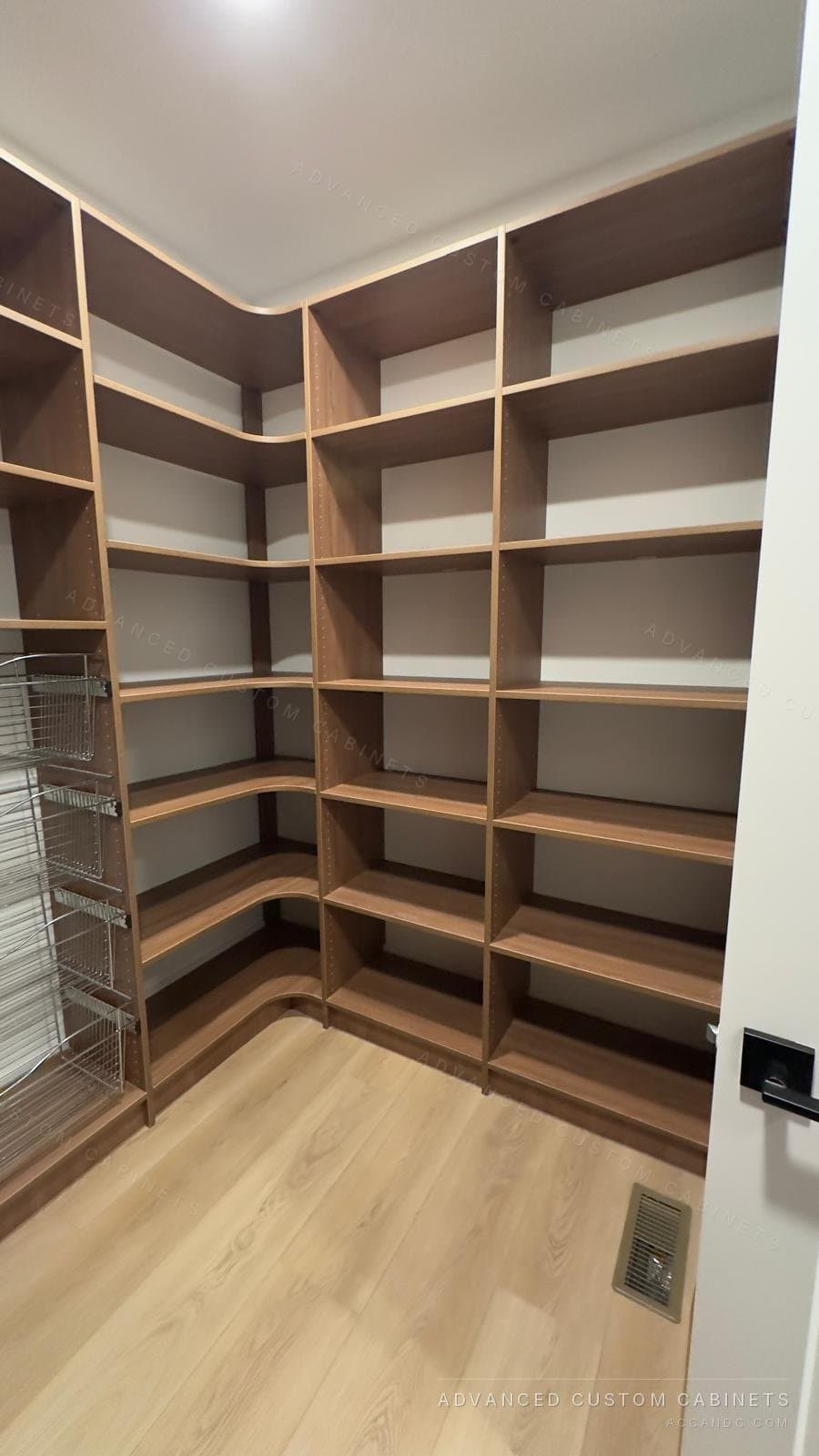
No family buys the same groceries for ten years, so the spacing in the table is a starting point, not a final answer. That is why pantry shelves should be adjustable. Cabinet-grade adjustable shelving uses the 32 mm system: columns of small holes drilled 32 mm, about 1 1/4 inches, apart up the side panels, with shelf pins that move to any hole. You can see the rows of holes on the side panels in the photo below.
One or two shelves in a tall section are usually fixed. A fixed shelf at counter height ties the sides of a tall unit together and keeps it square, and it gives a solid working ledge for unloading bags. Everything above and below it moves.
The reach band: where everyday food goes
Height decides what gets used. The federal accessibility standards set the unobstructed reach range at 15 to 48 inches above the floor, and at 44 inches when you reach over a counter about 24 inches deep (2010 ADA Standards, sections 308.2 and 308.3). They were written for wheelchair users, but they also make a good map of the shelves anyone can use without a step stool or kneeling:
- **15 to 48 inches:** the food you use every week, cans, cereal, pasta, snacks, oils.
- **Above 48 inches:** lighter things you use less often, backups of what is below, party platters, the paper plates.
- **Below 15 inches:** heavy and bulky items that are better slid than lifted, flats of water, pet food, potatoes and onions in baskets.
If children help themselves, give them one low shelf of their own for snacks and lunch-box items. It saves a lot of climbing.
Pull-outs, baskets and roll-out shelves
Anything deeper than about 16 inches needs to come to you. In a tall pantry cabinet, which is 24 inches deep like the rest of the kitchen, fixed shelves lose their back half; roll-out shelves on full-extension glides bring the whole shelf forward, so the last can is as easy to reach as the first. A pull-out tower, a frame on glides with baskets on both sides, does the same for a narrow cabinet beside the refrigerator.
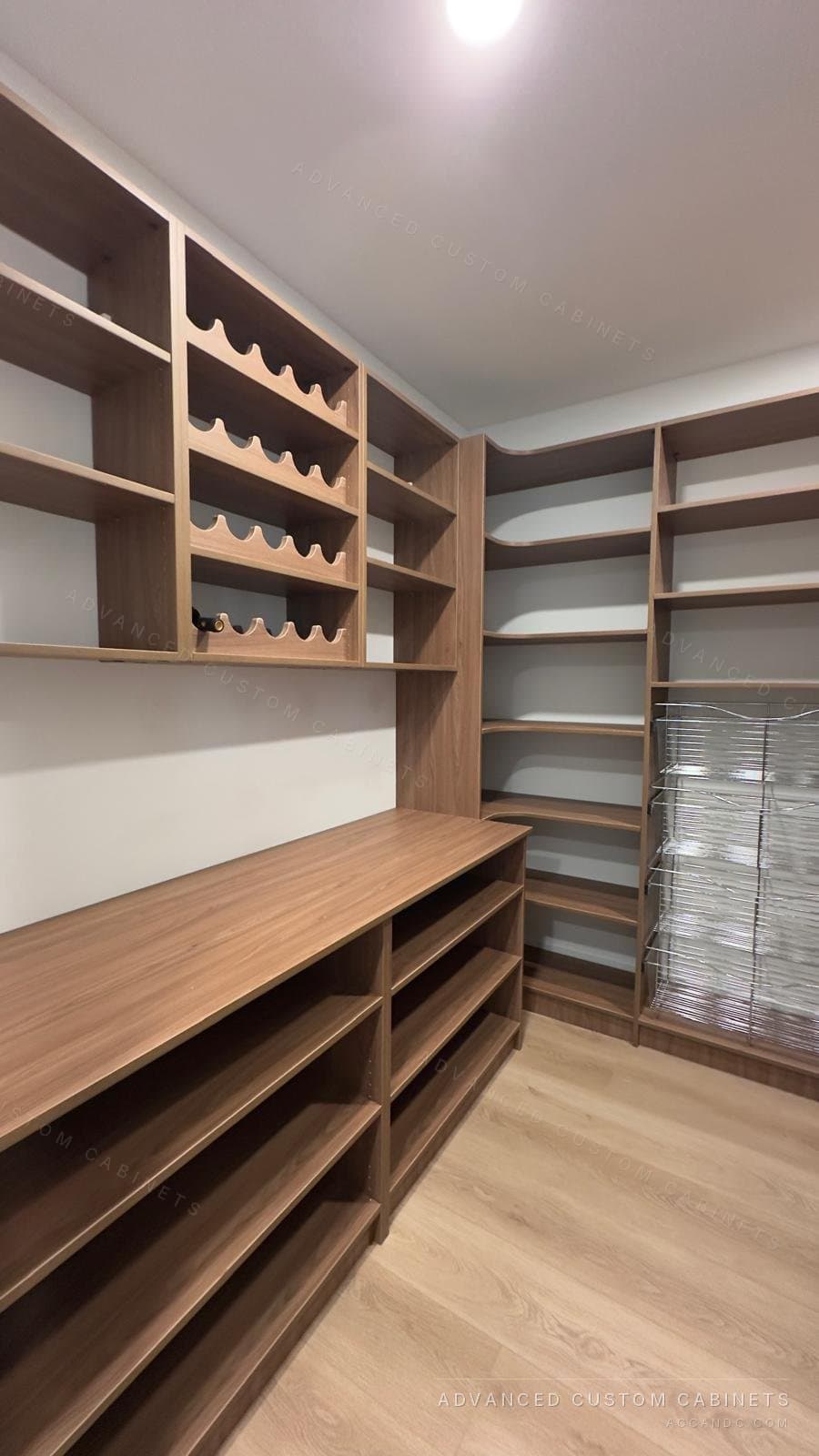
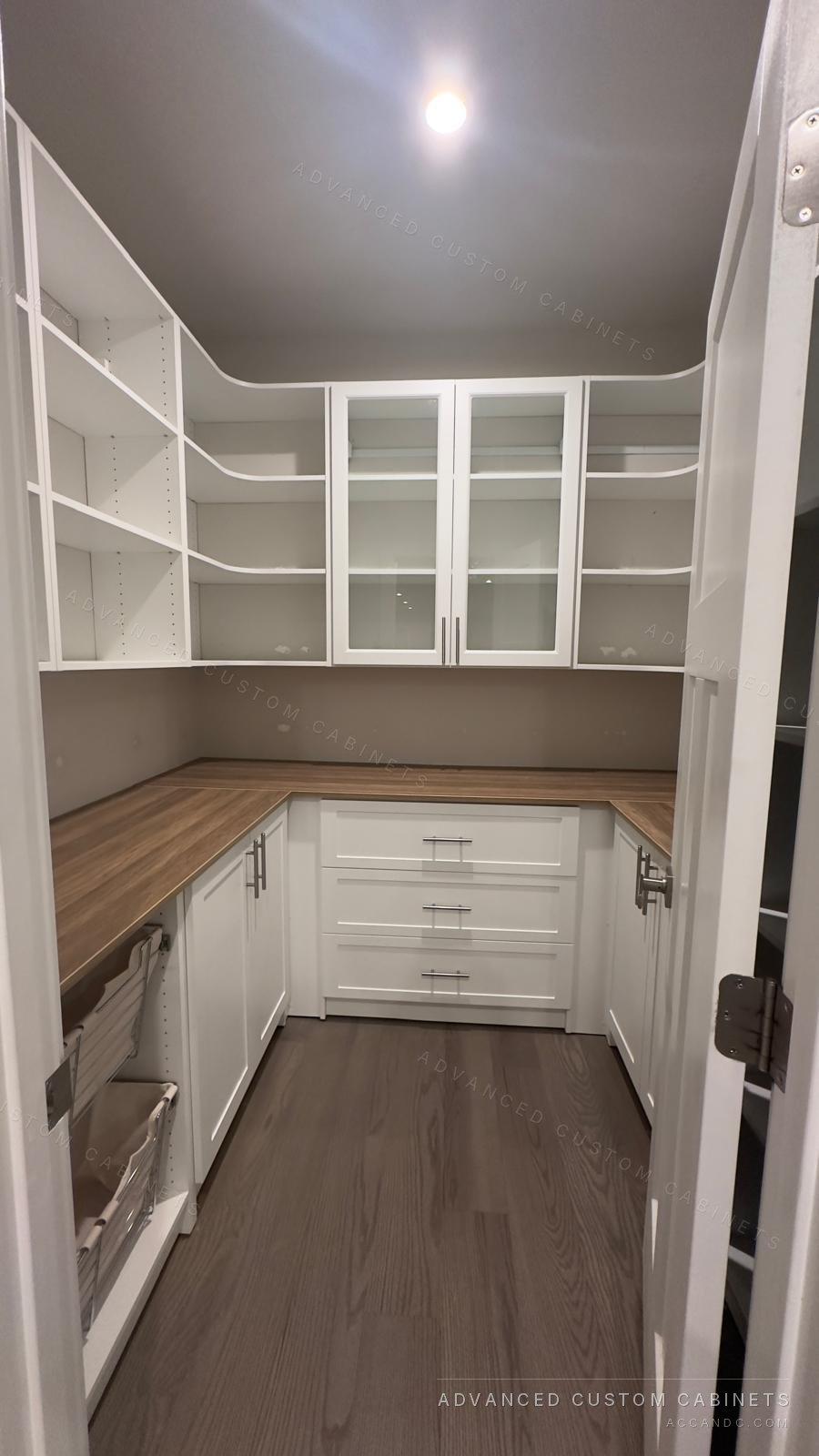
In a walk-in pantry, the lower section is the place for pull-out wire baskets. They hold onions, potatoes, bread and bags of snacks where air moves around them, and they slide out instead of making you kneel to see the back. Drawers do the same job for things that should be hidden, such as the lunch-box supplies and the foil and wrap.
Corners and the ends of a run
Where shelves from two walls meet, the corner square is the part nobody reaches. Curved corner shelves solve it by sweeping the shelf front around the corner in an arc, so the corner becomes the most visible shelf in the pantry instead of the darkest. You can see them in both pantry photos in this guide.
The end of a short run, beside the door or the window, is good for narrow shelving 6 to 8 inches deep. That depth is just right for spices, cans in a single row and jars, with nothing hiding behind anything. A rack on the inside of the pantry door adds about 6 inches of the same storage, as long as the door swings out of the pantry rather than into it.
Small pantries: the pantry closet and the tall cabinet
A pantry closet 24 inches deep behind a door holds far more than its size suggests when it is shelved on three sides. Run 12-inch shelves across the back wall, narrower shelves of 8 to 10 inches on the side walls so they do not block the corners, and a door rack on the inside of the door. The back shelves stop a few inches short of the side walls so you can reach past the side shelves into the corners.
A tall pantry cabinet in the kitchen, 18 to 36 inches wide, works best with roll-out shelves in the lower two thirds and adjustable fixed shelves above for the lighter items. The walk-in pantry vs pantry cabinets guide compares the two kinds of pantry if you are still choosing between them.
Shelf material and span
A shelf of cans is heavy, and a shelf that bows is the first thing everyone notices. Our shelves are 3/4-inch or 1-inch laminated board or 3/4-inch plywood with 2 mm PVC edges, which wipe clean after a spill and do not swell from the occasional damp bottle. The number to watch is span: a 3/4-inch laminated shelf loaded with books sags past 30 to 32 inches between supports, so pantry sections are kept at or under 30 inches wide, or the shelf is made 1 inch thick, or a vertical divider is added. The same rule is explained for bookcases in the built-in bookshelves guide.
Where the pantry goes, and what to keep away from it
The best shelving will not help food stored in the wrong place. The USDA advises storing canned and shelf-stable food in a cool, dry place, says temperatures below 85 degrees F are best and that heat over 100 degrees F harms canned goods, and warns against keeping it above or beside the stove, under the sink, or in a damp garage or basement (USDA Food Safety and Inspection Service, Shelf-Stable Food Safety). The same page puts the storage life of high-acid canned food such as tomatoes and fruit at 12 to 18 months and low-acid canned food such as vegetables and meat at 2 to 5 years.
In practice that means a pantry wall should not be the wall behind the range or the wall vented by the dishwasher, and a basement pantry needs a dry room rather than an unfinished corner by the water heater. In a Philadelphia-area house, a hall closet or a small room next to the kitchen on an interior wall is usually the steadiest spot, away from both the range and the drafts of an outside wall in January.
How the planning is done
A designer visits your home anywhere in the Philadelphia area for free, measures the pantry, and asks what you buy and how you shop, so the depths, spacings and pull-outs match your groceries rather than a catalog. You see the shelving in a 3D drawing before anything is built. Our custom pantries are made in our Warminster, PA shop, usually within 2 to 4 weeks, and installed by our own crew, with a lifetime limited transferable warranty. To book a visit, call (267) 888-6680 or send a request through the contact page.
Questions people ask
How deep should pantry shelves be?
Twelve inches for cans, jars, boxes and bottles; 14 to 16 inches for small appliances and bulk items, kept low; 18 to 20 inches only at counter height, where the shelf becomes a working surface. Deeper shelves hide the back row.
How far apart should pantry shelves be?
Seven to 8 inches for cans, 12 to 14 inches for cereal boxes and bottles, and 16 to 18 inches for a stand mixer or slow cooker. Make the shelves adjustable so the spacing can change with what you buy.
What height should pantry shelves be for everyday food?
Keep the food you use every week between about 15 and 48 inches off the floor, the reach range in the federal accessibility standards. Lighter, less-used items go above, heavy and bulky items below.
Are pull-out shelves worth it in a pantry?
In anything deeper than about 16 inches, yes. A tall pantry cabinet 24 inches deep loses its back half with fixed shelves; roll-out shelves on full-extension glides bring the whole shelf to you.
How do you organize a small pantry closet?
Shelve three sides: 12-inch shelves on the back wall, 8 to 10 inch shelves on the side walls, and a rack on the inside of the door. Stop the back shelves short of the side walls so the corners stay reachable.