Three words, three different products
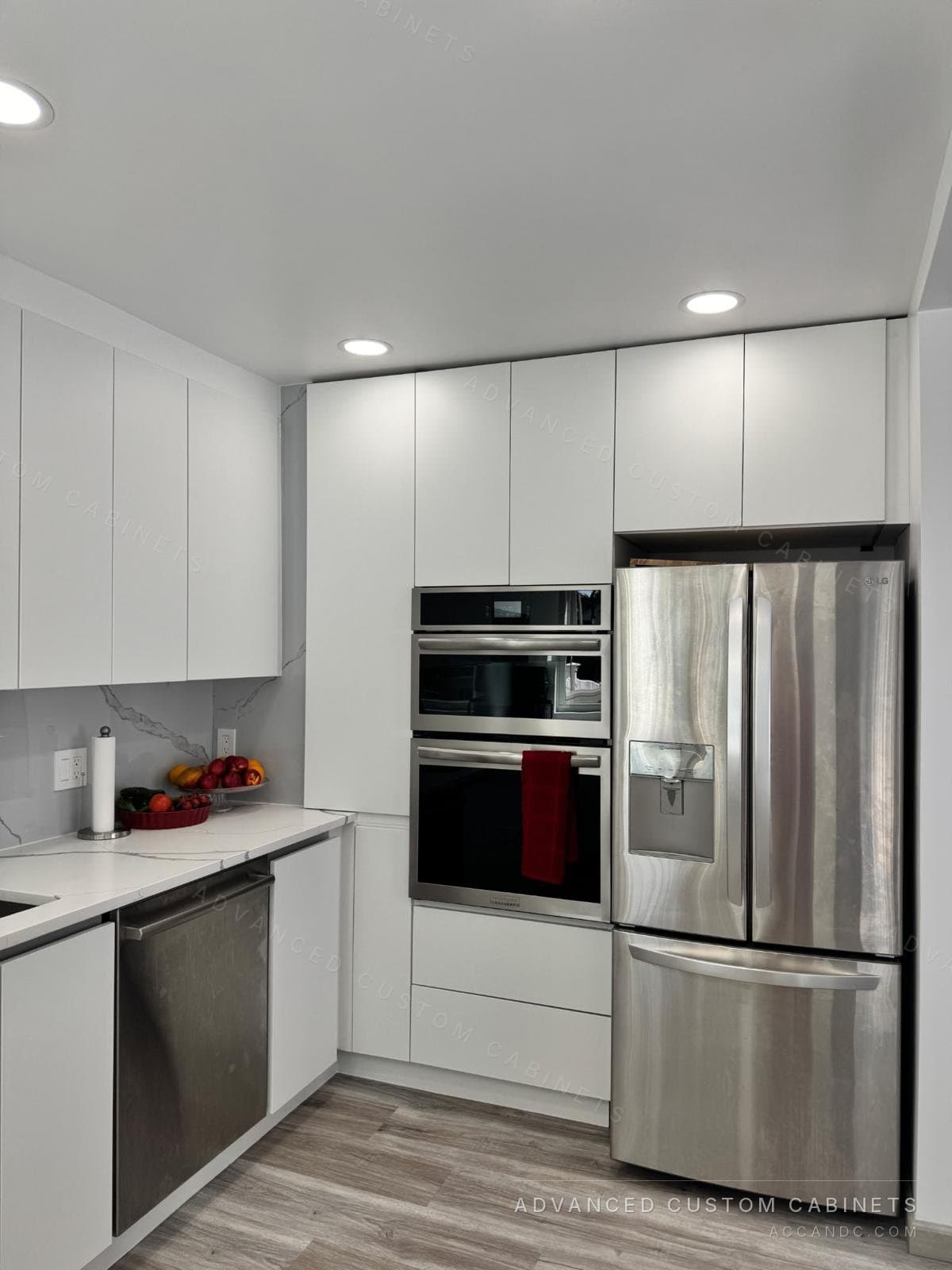
Stock cabinets are made in advance in fixed sizes and finishes and sold off the shelf or from a warehouse; you buy the boxes that come closest to your walls. Semi-custom cabinets come from a catalogue with more sizes, finishes and interior options and are built to order in a factory, still on a size grid. Custom cabinets are drawn to your room, built in a shop to those drawings, and installed by the people who built them. The price gap between the three is real, and so is the gap in what you get; the rest of this guide is about the second gap.
The 3 inch grid
Stock and most semi-custom cabinets come in widths from 9 to 48 inches in 3 inch steps, in two depths, 12 inches for uppers and 24 for bases, and in upper heights of 30, 36 and 42 inches. A wall that measures 127 inches therefore gets 126 inches of cabinets and a 1 inch filler strip, or 123 inches and a 4 inch one, and the run ends short of the ceiling by whatever the grid leaves. Custom cabinets are built to 127 inches and to the ceiling. On one wall the difference is a filler; on a kitchen with four walls, a window and a range hood it is a row of fillers and a soffit nobody wanted.
Corners are where the grid costs the most. A stock run turns a corner with a blind cabinet or a dead corner, 24 inches of box you cannot reach into; a custom run turns it with a corner pull-out or a lazy susan sized to that corner, and the dead space is a drawer.
| Stock | Semi-custom | Custom | |
|---|---|---|---|
| Sizes | 3 inch grid, fixed depths | 3 inch grid, some depth options | Any width, depth and height |
| Walls out of square | Fillers and scribe moulding | Fillers and scribe moulding | Scribed panels, built to the measurements |
| Corners | Blind or dead corner | Blind corner, lazy susan options | Corner pull-outs and lazy susans sized to the corner |
| Interiors | Shelves | Catalogue of pull-outs | Pull-outs, dividers, appliance garages where you need them |
| Finishes | A few | A catalogue | 25 in stock, more on request |
| Who installs | You or a contractor | A contractor | The shop's own crew |
Inside the boxes
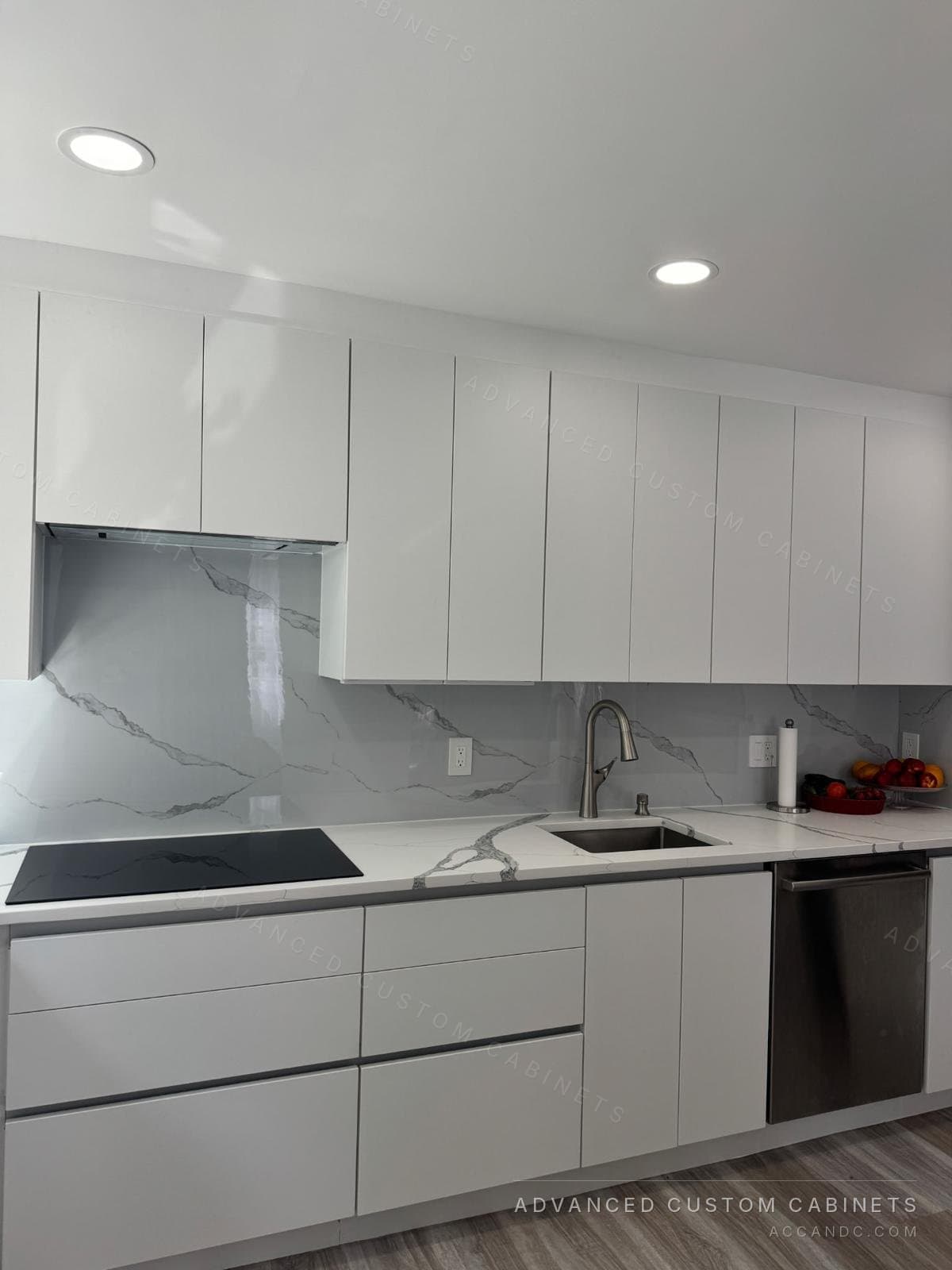
What makes a kitchen work day to day is inside the doors: pull-out drawers in the base cabinets instead of shelves you kneel for, corner pull-outs and lazy susans, spice pull-outs beside the range, tray dividers over the oven, trash and recycling pull-outs by the sink, an appliance garage for the mixer, and tall pantry towers with pull-out shelves. Custom cabinets put each of those where your kitchen needs it rather than where the catalogue offers it. Soft-close hinges and full-extension drawer glides are the hardware that makes a drawer of pans usable, and they are standard in ours.
Frameless construction, the European style, has no face frame across the front of the box, so the opening is the full width of the cabinet and the drawers are wider for the same cabinet. It is also why handleless fronts and flush doors work: the doors cover the whole box edge to edge.
What the box is made of
Our boxes are three-quarter and 1 inch laminated particle board or three-quarter inch plywood, with a 2 mm PVC edge banding glued under pressure rather than a thin T-moulding pressed on; the thick edge is what does not chip at the drawer front or peel by the dishwasher. The laminate comes in 25 in-stock colours across wood grains, solids, ultra-matte and high-gloss, with more on request, and the door and drawer fronts come in the full range. Ask any supplier the same three questions: how thick is the board, what is the edge, and what is the hinge.
Walls that are not square, ceilings that are not level
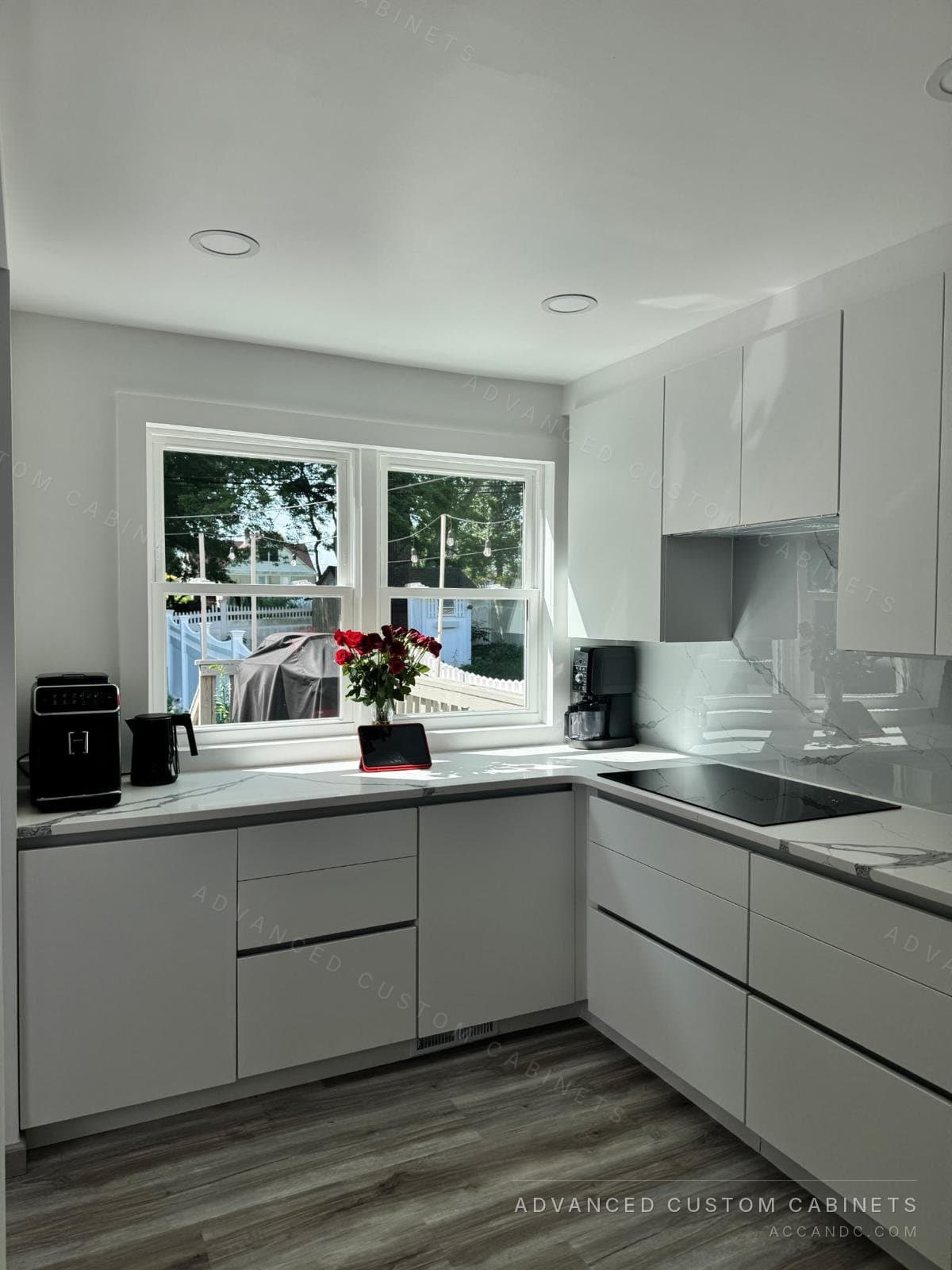
Rowhouses in Philadelphia and pre-war twins in Montgomery and Delaware counties rarely have a square corner or a level ceiling, and the 1950s ranches in Bucks are not much better. A grid cabinet meets that wall with a filler and a scribe moulding; a custom cabinet is built to the measurements the designer takes, with panels scribed to the wall and the fronts aligned to the ceiling line. It is the difference you see at the end of a run, at the window, and above the refrigerator.
Lead times and the day of installation
Stock cabinets are in stock, which is their advantage. Semi-custom cabinets are typically 4 to 8 weeks from order. Our custom kitchens are designed, built and installed within 2 to 4 weeks of the in-home consultation, depending on finish availability, and the installation itself spans one to two days for most kitchens. The cabinets arrive built; the time on site is leveling, fitting and the fronts. We build new cabinets only; we do not reface or repaint existing ones.
When stock is the right answer
A rental unit, a house being sold, or a simple galley with square walls, no corner and a standard 8 foot ceiling: stock cabinets fit, cost less and arrive this week. Custom earns its place in a kitchen with a corner, a window in the run, a ceiling above 8 feet, walls that are not square, or a cook who wants the pull-outs where they cook.
The quote
A custom quote is built from drawings of your kitchen: a fixed price with a 3D mockup, not an estimate per linear foot that moves on install day. Comparing it with a stock or semi-custom quote means comparing the same list: board thickness, edge, hinges, pull-outs, delivery and installation, because a stock price often stops at the boxes. We beat any competitor's quote on a comparable system.
How the planning is done
A designer measures the kitchen on a free in-home visit, including the corners, the ceiling and the appliances, and sketches the layout on the spot. The cabinets are drawn in 3D, quoted at a fixed price, built in our Warminster, PA shop and installed by our own crew. Every cabinet carries a lifetime limited transferable warranty.
Questions people ask
What is the difference between stock, semi-custom and custom kitchen cabinets?
Stock cabinets come ready-made in fixed sizes on a 3 inch grid; semi-custom cabinets come from a catalogue with more sizes and options, built to order on the same grid; custom cabinets are drawn to your room, built in a shop and installed by its crew.
Why do stock cabinets need filler strips?
Because they come in widths from 9 to 48 inches in 3 inch steps, so a wall that measures 127 inches gets 126 inches of cabinets and a filler. Custom cabinets are built to the wall and to the ceiling.
Do custom kitchen cabinets take longer than stock?
Stock is in stock. Semi-custom is typically 4 to 8 weeks. Our custom kitchens are designed, built and installed within 2 to 4 weeks of the in-home consultation, depending on finish availability, with one to two days on site.
What are custom kitchen cabinets made of?
Ours are three-quarter and 1 inch laminated particle board or three-quarter inch plywood with a 2 mm PVC edge, soft-close hinges and full-extension drawer glides, in 25 in-stock colours with more on request.
Do you reface or repaint existing kitchen cabinets?
No. We build new cabinets to the room; refacing and repainting are different trades.